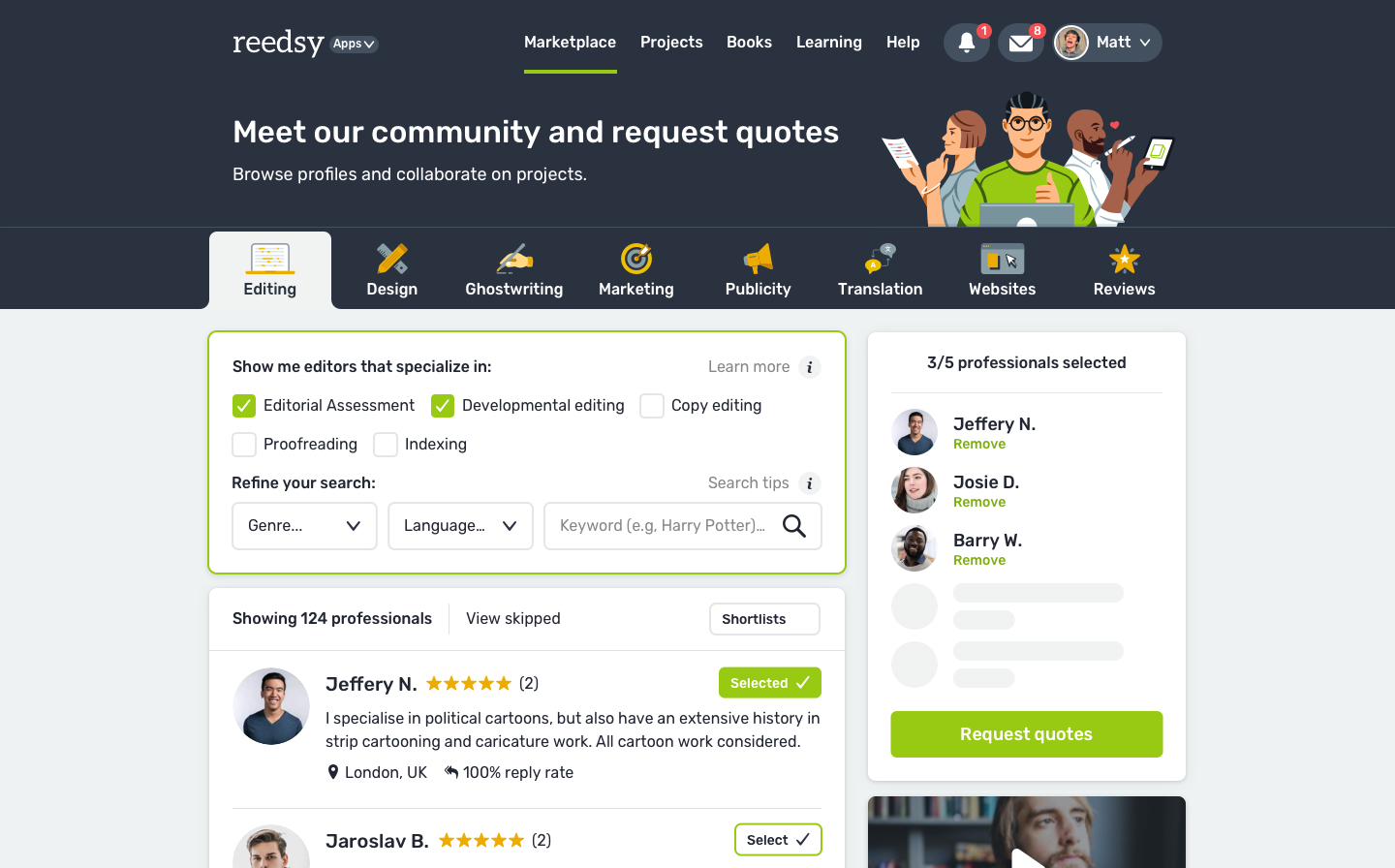
Meet the copy editors behind bestsellers
A copy editor does more than address grammatical errors. They improve your manuscript's readability, ensure your book adheres to the right style sheet, and fine-tune your prose.
On Reedsy, meet editors with years of copy editing experience at Big 5 publishers. Our editors have an ear for beautiful, readable sentences and understand the ins and outs of different style guides.
Hire a professional

Vicky H.

One of the world's most successful children's fiction editors, responsible for Erin Hunter, Daisy Meadows, Lauren Brooke and many more.
Request a quote
Melissa P.
Highly experienced, dynamic and astute Australian developmental and line/copy editor. I have a global client base.
Request a quote
Aaron L.
Editor in Chief of an art & lit website and English educator who loves all forms of creative writing—both poetry and prose.
Request a quoteWhat can you expect from a Reedsy copy editor?
A copy editor is a type of editor who polishes a piece of writing, ensuring it's error-free, consistent in style, and readable. While they do check grammar and punctuation, they primarily focus on improving clarity, cohesion, and accuracy while adhering to established style sheets.
On Reedsy, you can expect for editors to thoroughly go through your text, making changes that include eliminating redundancies while making sure that your own personal style remains intact through smaller details such as hyphenation and capitalization.
Importantly, a copy editor will also strengthen the prose throughout. They will substitute weak words, phrases, and sentences with powerful alternatives, often restructuring sentences for improved clarity. Once your manuscript has been copy edited, it will become more efficient, accurate, and focused on your voice.
Note that while the purview of a copy editor will vary from contract to contract, most copy editors will not handle "big picture" issues such as characterization, plot, or structure. Those responsibilities fall to a developmental editor. Copy editing takes a closer view of a manuscript by focusing on individual sentences and paragraphs.
Assemble your team
Request quotes from up to 5 professionals in your genre with a free Reedsy account.